Published September, 2026 | Sources: New York State Department of Taxation and Finance (NYS DTF) | tax.ny.gov
New York sales tax filing involves a little more than adding up what your customers paid and cutting the state a check. Registered vendors have to report gross sales, nontaxable and exempt sales, taxable sales, purchases subject to use tax, credits, and any applicable special taxes and fees. Depending on your filing status, you may also need to break sales out by jurisdiction or complete additional schedules on top of that.
The good news? New York provides a free online filing system that does most of the heavy lifting for you. The catch? You still have to put the right numbers in the right places.
This guide covers everything you need for accurate, on-time New York sales tax filing: how often you’re required to file, when returns are actually due, how to file through Sales Tax Web File, why zero returns still matter, and what it costs you if a deadline slips by.
Need the bigger picture first?
New York Sales Tax Filing Quick FAQ
Any business registered as a New York State sales tax vendor must file a sales and use tax return for every assigned reporting period, even when there were no taxable sales, no taxable purchases, and no tax due.
New York assigns each vendor an annual, quarterly, or part-quarterly (monthly) filing schedule. Most new vendors start out quarterly unless their registration details qualify them for annual filing, and your frequency can shift later based on tax liability or sales volume.
Returns are due 20 days after the end of the reporting period. Annual returns are due March 20. Quarterly returns are due June 20, September 20, December 20, and March 20. Monthly returns are due on the 20th of the following month. If a deadline lands on a weekend or legal holiday, it rolls to the next business day.
Most sales tax filers are required to e-file through Sales Tax Web File. Quarterly filers use Form ST-100. Annual filers use Form ST-101. Monthly filers use two forms: ST-809 for their monthly returns, and ST-810 to reconcile the full quarter.
In most cases, yes. If you prepare your own returns using a computer and have broadband Internet access, you’re required to Web File.
Yes. New York requires a return for every reporting period tied to an active sales tax account, even if there were no sales or tax due. A zero return filed late still triggers a $50 penalty.
New York can impose both penalties and interest. The minimum penalty for filing late is $50, even with zero tax due. Interest accrues from the due date until payment and compounds daily. For the third quarter of 2026, the sales and use tax late-payment interest rate is 14.5% annually, and the published rate for quarter four holds the same rate.
Yes. Eligible quarterly and annual filers can claim a vendor collection credit equal to 5% of the taxes and fees reported, up to $200 per reporting period. The return must be filed on time and paid in full. Monthly filers and PrompTax participants are not eligible.
Yes. If you make both marketplace-facilitated sales and independent sales, include the marketplace-facilitated sales in your gross sales figure and in your nontaxable sales.
Understanding New York Sales Tax Filing Frequencies
Before you file anything, it helps to know which return New York expects from you and how often. Fortunately, you don’t have to guess—the Tax Department assigns your filing frequency and notifies you whenever it changes.
Here’s how the primary categories break down:
| Filing Frequency | Requirements | Filing Period |
|---|---|---|
| Annual | Annual sales and use tax due is $3,000 or less | March 1 – February 28/29 |
| Quarterly | Combined taxable receipts, purchases, rents, and amusement charges are under $300,000 in the previous quarter | Q1: Mar 1 – May 31 Q2: June 1 – Aug 31 Q3: Sep 1 – Nov 30 Q4: Dec 1 – Feb 28/29 |
| Part-Quarterly (Monthly) | Combined taxable receipts, purchases, rents, and amusement charges hit $300,000 or more in a quarter | Monthly |
Once you’re classified as a monthly filer, plan on staying there. New York keeps you on monthly filing until you fall back under that $300,000 threshold for four consecutive quarters.
There’s also a remittance schedule that isn’t technically a filing frequency, but deserves a mention: PrompTax. Larger businesses (generally those with annual sales and use tax liabilities exceeding $500,000) are required to pay tax on an accelerated schedule and file a quarterly return reconciling the previous fiscal quarter’s payments. If you’re required to participate, the Tax Department will notify you by mail.
Haven’t registered for New York sales tax yet?
When Are New York Sales Tax Returns Due?
Across every filing frequency, the rule is the same: returns are due no later than 20 days after the end of the reporting period. The wrinkle is that New York’s sales tax year runs from March through February, not January through December—so if you’re used to calendar-year deadlines, these dates will feel a little offbeat.
| Reporting Period | Dates Covered | Due Date |
|---|---|---|
| Quarter 1 | March 1 – May 31 | June 20 |
| Quarter 2 | June 1 – August 31 | September 20 |
| Quarter 3 | September 1 – November 30 | December 20 |
| Quarter 4 | December 1 – February 28/29 | March 20 |
| Annual | March 1 – February 28/29 | March 20 |
| Monthly | Each month | 20th of the following month |
| Quarterly reconciliation (monthly filers) | Each NY sales tax quarter | 20th day after quarter end |
If the 20th falls on a weekend or legal holiday, the deadline moves to the next business day. PrompTax participants layer their own accelerated payment schedule on top of this—payments are due on the third business day after the 22nd of each month—but they still file the quarterly return by the standard 20-day deadline to reconcile everything.
Filing in more than just New York?
How to File New York Sales Tax Returns
Nearly every New York vendor is required to file electronically through Sales Tax Web File. Here’s exactly how New York sales tax filing works, from account setup to submission.
Step 1: Create Your Tax Online Services Account
When you registered for sales tax in New York, your Certificate of Authority should have arrived by mail along with a PIN. That PIN is what you use to create your Tax Online Services account.
To set it up:
- Go to the Tax Online Services Portal and select Create account
- Select Business as they account type
- Enter your Taxpayer ID number (your EIN or New York State tax identification number)
- If you have your PIN letter, select Yes and enter your five-digit PIN; if not, select No and answer the follow-up questions instead
- Click Continue
- Fill in your name, email address, and phone number, then choose a username and password
- Submit
Step 2: Gather Your Filing Information
Before you log in to file, have the following on hand:
- Total gross sales for the period
- Nontaxable and exempt sales
- Taxable sales, broken out by jurisdiction
- Purchases subject to use tax
- Sales tax, use tax, and any special taxes collected
- Your sales tax identification number, from your Certificate of Authority
- Bank account and routing number for payment
- Records of any Schedule A, B, FR, H, N, T, or W activity that applies to your business (restaurant meals, utilities, motor fuel, clothing, NYC personal services, telephone services, or QEZE purchases, respectively)
Step 3: Log In and Navigate to Your Return
The steps below walk through filing a quarterly return; monthly and annual filers might see slight variations when filing.
- Log in to your Business Online Services account
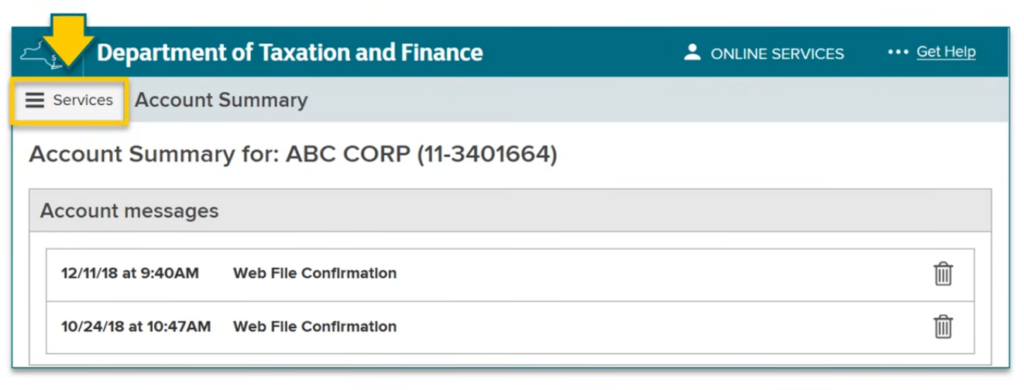
- Select the ≡ Services menu from your Account Summary homepage
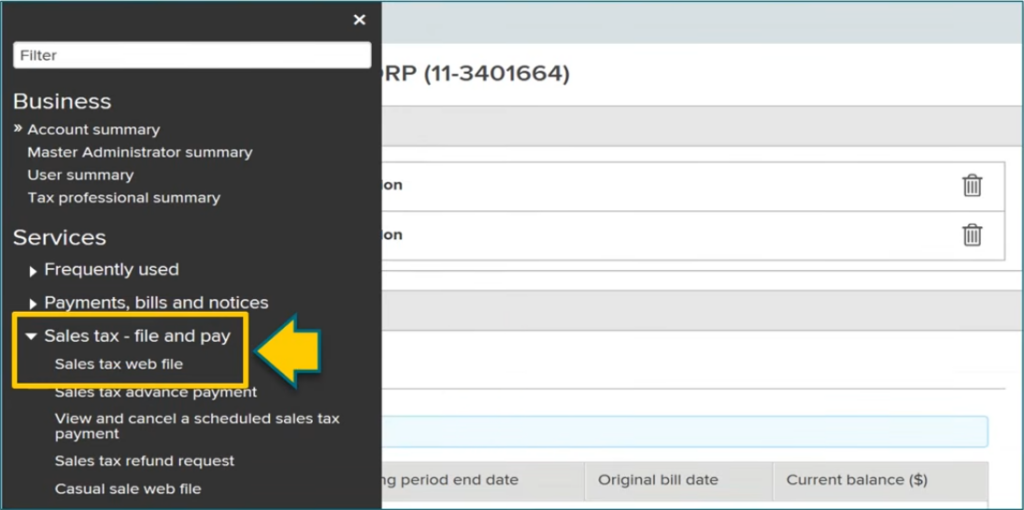
- Select Sales tax – file and pay, then Sales tax web file from the expanded menu
- Click Start New Return
Step 4: Enter Your Sales and Purchase Details
Work through the return in order:
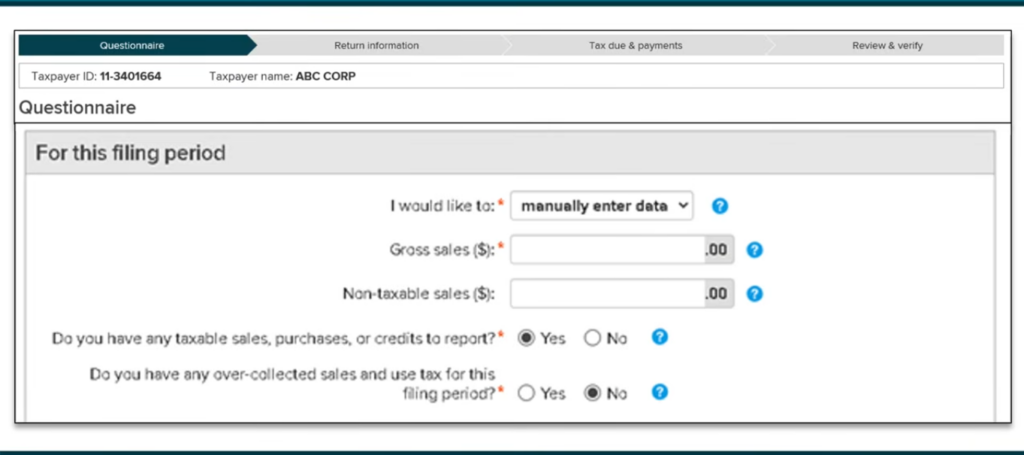
- Enter your gross sales for the period, including all taxable, nontaxable and exempt sales (plus anything sold through a marketplace facilitator)
- Enter your non-taxable sales
- Indicate whether your have any purchases, credits, or over-collected sales and use tax to report for the period, then click Next
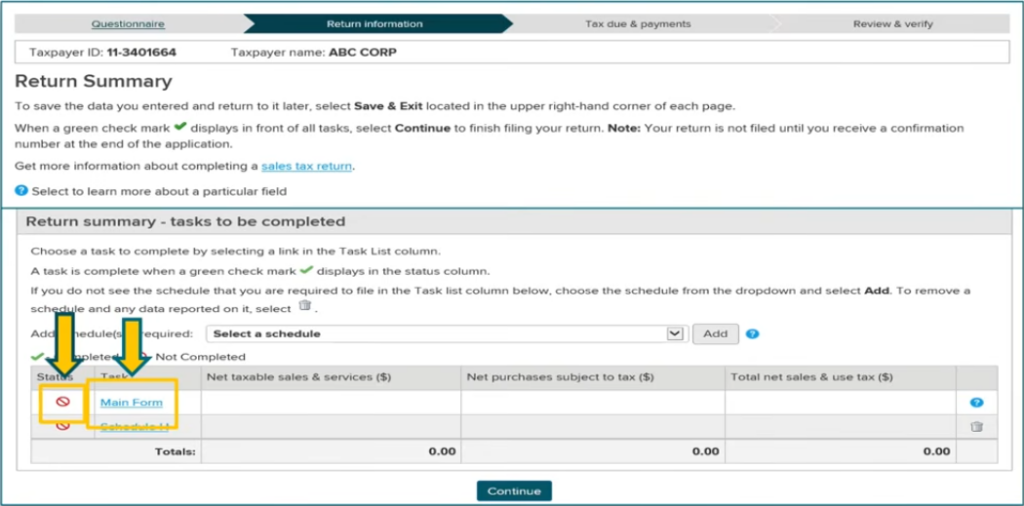
- The Return Information page, select the Main Form first to enter your taxable sales by jurisdiction
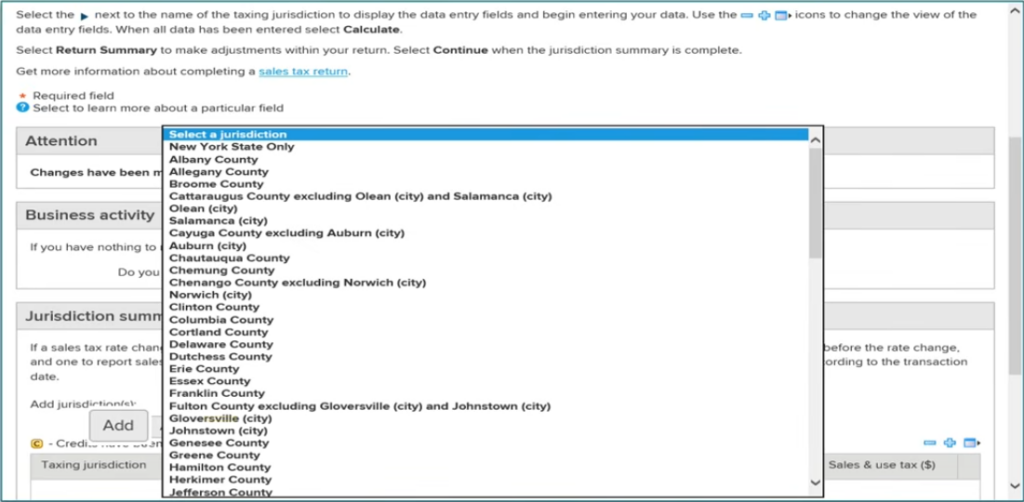
- Under Jurisdiction Summary, choose the cities, counties, or districts where you made sales and select Add
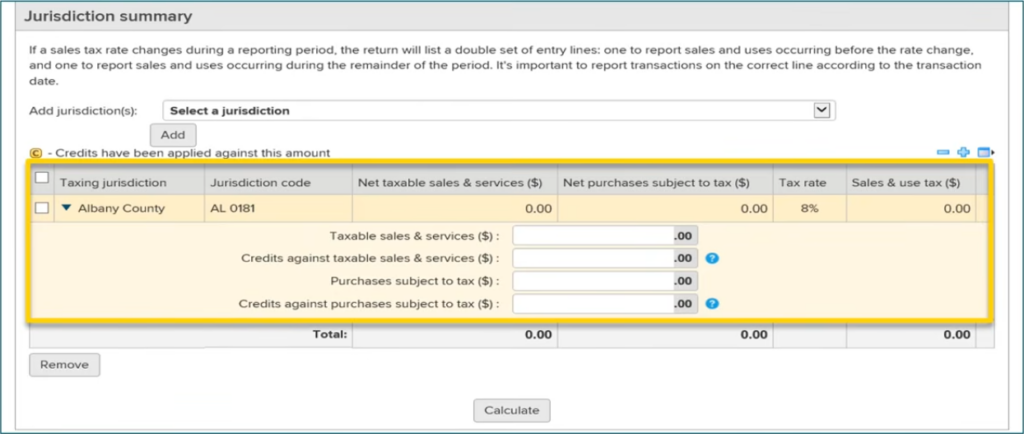
- Your selected jurisdiction will appear, along with its jurisdiction code and tax rate; click the arrow besides its name
- Enter your taxable sales, credits, and purchases for that location
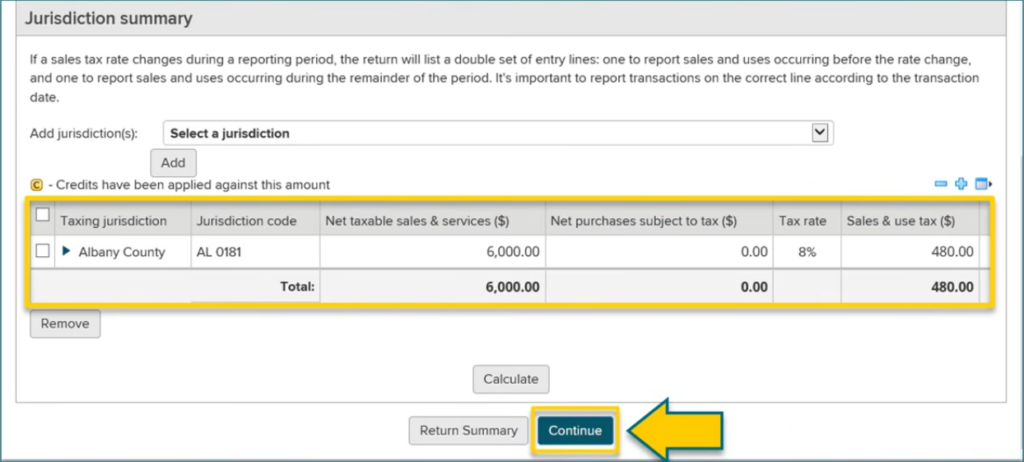
- Click Calculate, and repeat for each jurisdiction where you had taxable sales
- Once everything is entered, select Continue
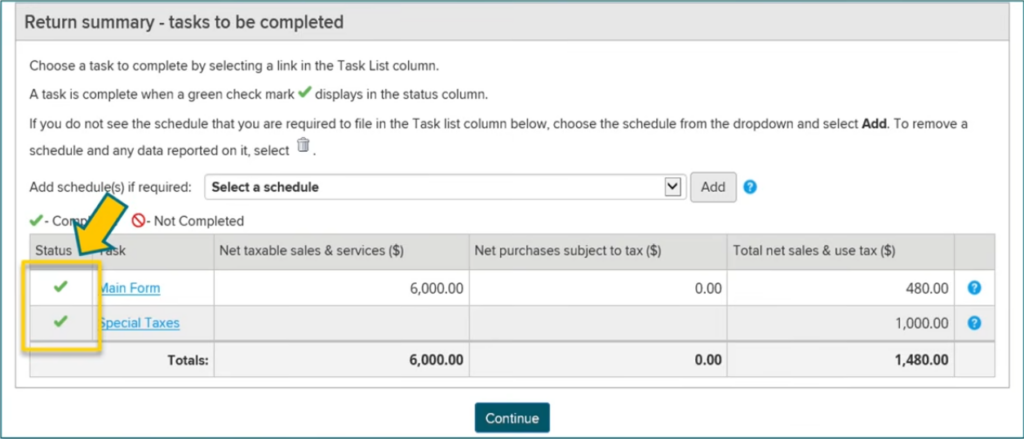
- If applicable, you’ll be routed to enter any special taxes and fees
- Once every required form and schedule shows a green check mark under the status bar, click Continue
Step 5: Pay, Review, and Submit
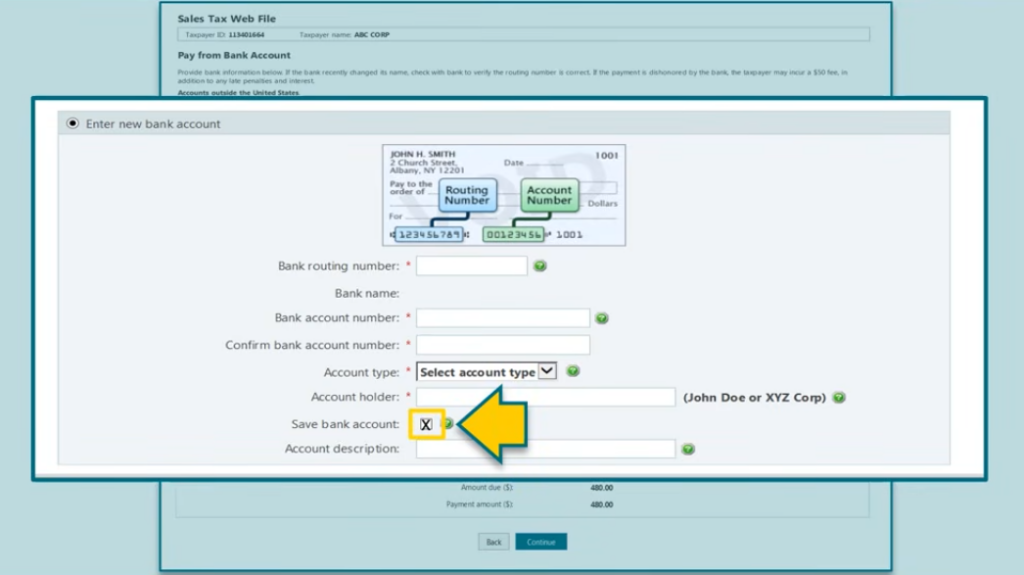
If you owe tax, enter your bank account information to pay directly (and save it for next time, if you’d like).
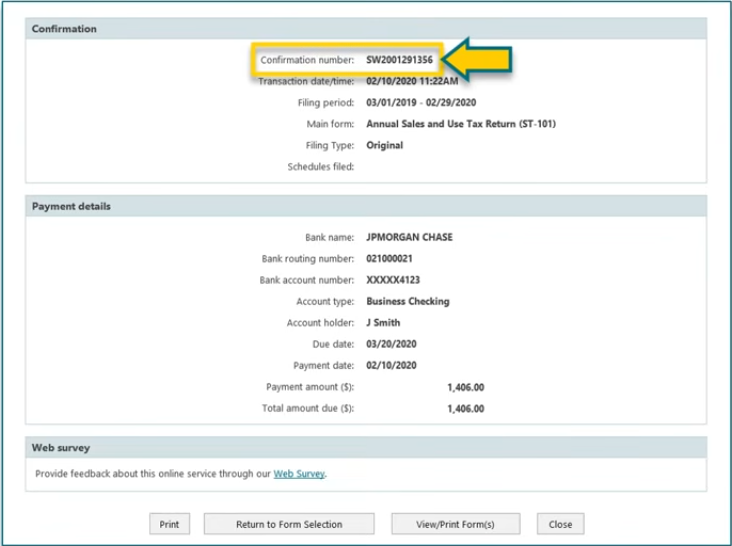
Review your return carefully—jurisdiction codes and local rates are where most errors sneak in—then click Submit. You’ll land on a confirmation page. Print or save it; that confirmation is your proof of timely filing if a notice or audit question ever comes up.
Why You Must File Even When No Tax Is Due
A slow quarter doesn’t excuse you from filing. As long as your Certificate of Authority is active, New York expects a return for every assigned period, including periods with zero sales and zero tax collected.
Filing a zero return through Web File takes only a few minutes:
- Start your return as usual
- Enter your gross sales (zero, if you had none)
- Answer No to “Do you have any taxable sales, purchases, or credits to report?”
- Select Continue
- Select Calculate on the Tax Due Details page
- Select Continue
- Review your return and Submit
- Print or save your confirmation
If your business has genuinely stopped making taxable sales in New York, don’t let zero returns pile up indefinitely. File a final return and formally close your account instead.
Tired of tracking zero returns?
New York Vendor Collection Credit for Timely Filing
File and pay on time, and New York lets you keep a small slice of what you collected. It’s called the vendor collection credit, and it comes with some conditions:
You must file on a quarterly (ST-100) or annual (ST-101) basis, and the return must be filed on time with everything owed paid in full. Miss either condition, and the credit disappears for that period. Monthly filers and PrompTax participants don’t qualify at all, regardless of how promptly they file.
The credit equals 5% of the taxes and fees reported, capped at $200 per reporting period. It applies to state and local sales/use taxes, several supplemental taxes (passenger car rentals, vapor products, certain entertainment and information services), the NYC hotel unit fee, and net credit for prepaid fuel sales tax.
If you’re eligible, Web File calculates and applies the credit automatically to your total remittance due. It’s not going to make anyone rich, but it’s a nice little reward for doing New York sales tax filing the right way.
New York Late Filing Penalties and Interest
Where the vendor collection credit rewards promptness, New York’s penalty structure punishes the opposite—and it escalates the longer a return sits unfiled. Here’s exactly what’s at stake:
| Penalty Type | Rate |
|---|---|
| Failure to File (no tax due) | $50 flat |
| Late filing, 60 days or less | 10% of the tax due for the first month, plus 1% for each additional month or partial month, capped at 30%; minimum $50 |
| Failure to filing, or filing more than 60 days late | The greatest of: the formula above (capped at 30%); or the smaller of $100 or 100% of the tax required to be shown on the return |
| Late payment (filed on time, tax unpaid) | 10% of the tax due for the first month, plus 1% for each additional month or partial month, capped at 30% |
| Interest | Compounds daily and is adjusted quarterly. Currently 14.5% annually on late payments and assessments (Jul 1–Sep 30, 2026); the published rate for Oct 1–Dec 31, 2026 holds at 14.5% |
| Fraud | Twice the unpaid tax, plus interest at the greater of 14.5% or the Tax Commissioner’s set rate |
And don’t forget: filing or paying late also disqualifies you from the vendor collection credit for that period, so a missed deadline effectively costs you twice.
Behind on New York sales tax filings?
Common New York Sales Tax Filing Mistakes to Avoid
- Skipping a return during a quiet period — a zero return is still required, and the minimum penalty is $50 even when nothing is owed
- Confusing New York’s fiscal sales tax year with the calendar year — periods run March through February, not January through December, and it’s an easy detail to miss when your other filings follow the calendar year
- Not reconciling ST-809 monthly payments against the quarterly ST-810 — part-quarterly filers need the full quarter’s activity to line up
- Forgetting required schedules — clothing exemptions, utility sales, NYC personal services, and telephone services each have their own schedule
- Using outdated jurisdiction codes or local rates — New York’s local rates vary by county and city, and software or spreadsheets that fall out of date will misstate your total
- Missing PrompTax’s accelerated payment schedule while still hitting the quarterly filing deadline — the two obligations run on separate clocks, and satisfying one doesn’t satisfy the other
- Not closing the account when a business stops operating — an open Certificate of Authority keeps generating filing obligations, and penalty exposure, until it’s formally closed with a final return
New York’s system has more moving parts than most states: its own fiscal year, three filing frequencies, an accelerated payment program for its biggest vendors, and a patchwork of local rates on top of the state’s 4%. But once the structure clicks, New York sales tax filing becomes a matter of tracking the right calendar and the right rates.
- New York State Department of Taxation and Finance: File sales tax returns
- New York State Department of Taxation and Finance: Filing Requirements for Sales and Use Tax Returns
- New York State Department of Taxation and Finance: 2026 tax filing dates
- New York State Department of Taxation and Finance: File online with Sales Tax Web File
- New York State Department of Taxation and Finance: Form ST-100, New York State and Local Quarterly Sales and Use Tax Return
- New York State Department of Taxation and Finance: Form ST-101, New York State and Local Annual Sales and Use Tax Return
- New York State Department of Taxation and Finance: Sales tax e-file mandate for monthly sales tax filers
- New York State Department of Taxation and Finance: Electronic filing mandate for business taxpayers
- New York State Department of Taxation and Finance: Sales and Use Tax Penalties
- New York State Department of Taxation and Finance: Interest rates: 2026
- New York State Department of Taxation and Finance: Vendor Collection Credit
- New York State Department of Taxation and Finance: Sales tax requirements for marketplace providers
- New York State Department of Taxation and Finance: PrompTax program
- New York State Department of Taxation and Finance: PrompTax: sales and use tax
- New York State Department of Taxation and Finance: Tax Online Services Portal
- New York State Department of Taxation and Finance: Online Services for businesses
- New York State Department of Taxation and Finance: How to Web File a sales tax no-tax-due return