Understanding Sales Tax in Arizona: Arizona TPT Guide

Sales Tax by State Guide for Businesses
Are you a business owner operating in or selling to customers in Arizona? If navigating Arizona sales tax feels like traversing the Grand Canyon, you're not alone. This guide covers everything you need to know about Arizona's version of sales tax—officially called Transaction Privilege Tax (TPT)—including nexus rules, what's taxable and what's not, registration. filing deadlines, and more.

Sales Tax Faqs

Economic Threshold Sales: 100,000
Statewide Tax Rate: 5.6%
Marketplace Facilitator Law: Yes

Contact Information

Arizona Department of Revenue

Updated June 3, 2026

Need help with Arizona sales tax filing?

Frequently Asked Questions About Arizona Sales Tax (TPT)

Does Arizona have a sales tax?

Not exactly. Arizona collects a Transaction Privilege Tax (TPT), which is a tax on the seller for the privilege of doing business in Arizona. However, sellers typically pass this cost on to customers, so it functions similarly to a sales tax.

What is the Arizona TPT rate?

The statewide TPT rate is 5.6%. Local jurisdictions (cities and counties) layer their own rates on top of this, bringing the average combined rate to 8.52%.

What is the economic nexus threshold for Arizona TPT?

Out-of-state sellers establish economic nexus in Arizona when their gross sales into the state reach $100,000 in the current or prior calendar year. Sales made through a registered marketplace facilitator do not count toward this threshold.

Do I need to collect Arizona TPT if I sell only through Amazon or eBay?

If you sell exclusively through a registered marketplace facilitator, that platform is responsible for collecting and remitting TPT on your behalf and you don’t need your own license.

Are groceries taxable in Arizona?

Most unprepared food items are exempt from Arizona state TPT. Local jurisdictions, however, may still apply their own rates. Prepared foods—restaurant meals, ready-to-eat deli items—are fully taxable.

Does Arizona have a sales tax holiday?

No, Arizona does not have any sales tax holidays. All purchases are subject to the normal combined TPT rate year-round.

How do I register for Arizona TPT?

You can register online at AZTaxes.gov, through Arizona Business One Stop, or by mailing paper form JT-1. For a detailed walkthrough of Arizona TPT registration, see our full guide: How to Register for Sales Tax in Arizona.

When are Arizona TPT returns due?

Returns are due by the 20th of the month. Monthly filers submit every month, quarterly filers submit the month after each quarter ends, and annual filers submit once per year on January 20th.

Do You Need to Collect and Remit Arizona TPT? 

Along with 45 other states and the District of Columbia, Arizona imposes a form of sales tax—officially called Transaction Privilege Tax (TPT), a tax for the privilege of doing business in the state. Unlike traditional sales tax, TPT is technically levied on the seller, not the buyer. That said, most sellers pass the cost along to their customers, so TPT functions much like sales tax in practice.

If your business has economic or physical nexus in Arizona, you are required to register, collect, and remit TPT.  

What Is Taxable in Arizona?

One of the most important things to get right about sales tax is knowing what to tax. Getting it wrong in either direction (over-collecting or under-collecting) can create a lot of problems. Here’s the overview of taxability in Arizona.

Arizona TPT applies to the retail sale of tangible personal property and certain enumerated services. Examples of taxable items and services include:

  • Retail goods
  • Prepared food
  • OTC medications
  • Short-term rentals (under 30 days)
  • Amusement and entertainment
  • Utilies
  • Telecommunications

Digital goods and software require careful attention:

  • Prewritten (canned) software is treated as tangible personal property and is taxable regardless of how it’s delivered.
  • Digital products like music downloads, movies, and e-books are also generally taxable.
  • SaaS and streaming services remain in a gray area, with taxability depending on how the product is classified and delivered. Because Arizona has limited statutory guidance on digital taxation, businesses selling software or digital products should confirm their specific situation with ADOR or a qualified tax advisor.

Unfortunately, because Arizona has limited statutory guidance on digital taxation, businesses selling software or digital products should confirm their specific situation with ADOR or a qualified tax advisor.

What Is Not Taxable in Arizona?

These are common TPT exemptions:

  • Unprepared groceries
  • Sales for resale
  • Purchases by qualifying nonprofits
  • Government purchases
  • Certain manufacturing purchases
  • Agricultural producers selling their own food products
  • Most professional services (labor only)
  • Long-term residential rentals (30+ days)
  • Custom-developed software (treated as a professional service)

Some of these exemptions require additional documentation. When a buyer claims an exemption, the seller must obtain a valid exemption certificate to document the tax-free transactions. Arizona uses two primary exemption forms:

  • Form 5000 – TPT Exemption Certificate: Used for general exempt purchases (nonprofits, government, manufacturing, agriculture, etc.)
  • Form 5000A – Arizona Resale Certificate: Used for purchases made for resale

Sellers must keep completed certificates on file. In an audit, the burden of proof falls on the seller, not the buyer.

Arizona TPT Taxability Matrix

The table below provides a quick-reference of how common product and service categories are treated under Arizona TPT:

Product/ServiceState TPTLocal TPTNotes
Groceries (unprepared)ExemptTaxableLocal jurisdictions may still tax
Restaurant mealsTaxableTaxablePrepared food is fully taxable
Clothing & footwearTaxableTaxable
Prescription drugsExemptExempt
OTC medicationsTaxableTaxable
Prewritten softwareTaxableTaxableTreated as tangible personal property
Custom-developed softwareExemptExemptTreated as a professional service
Digital downloads (music, video, e-books)TaxableTaxableTaxable since ownership/use rights transfer
Manufacturing machinery & equipmentExemptExemptDirect-use exemption applies
Farm equipmentExemptExempt
Resale purchasesExemptExemptRequires Form 5000A
Short-term rentals (under 30 days)TaxableTaxableHotels, Airbnb, etc.
Long-term rentals (30+ days)ExemptExemptExempt as of Jan 1, 2025
Professional services (labor only)ExemptExemptServices generally not taxed
Construction contractingTaxableTaxable
Marijuana (adult use)TaxableTaxableTPT + excise tax
Amusement & entertainmentTaxableTaxable

Do You Have Sales Tax Nexus in Arizona? 

Sales tax nexus is the connection between a business and a state that triggers a collection and remittance obligation. Arizona recognizes two types of nexus: physical and economic.

Physical Sales Tax Nexus

A business has physical nexus in Arizona if it has any tangible presence in the state, including:

  • A storefront, office, or warehouse in Arizona
  • Assets or property located in Arizona
  • Delivering merchandise into Arizona on company-owned vehicles on a regular basis
  • Employees, agents, or contractors working in Arizona
  • Installing or repairing property sold to Arizona customers

Economic sales tax nexus

Out-of-state sellers establish economic nexus in Arizona when their gross sales into the state meet or exceed $100,000 in the current or prior calendar year. This threshold does not include sales made through a registered Marketplace Facilitator.

Once you exceed the threshold, your obligation to register and collect begins the month following 30 days after crossing the $100,000 mark. You’re then required to continue collecting and remitting for the remainder of that calendar year and the full following year, even if your sales later drop below the threshold. This is known as trailing nexus.

For example: if your business exceeds $100,000 in Arizona sales on July 15, 2025, you must begin collecting Arizona TPT on September 1, 2025. You remain obligated through the rest of 2025 and all of 2026.

Are Marketplace Facilitators Required to Collect and Remit Arizona TPT? 

Yes. Since October 1, 2019, Arizona requires marketplace facilitators to register and collect TPT on behalf of their third-party sellers if they meet the $100,000 economic nexus threshold.

If you sell exclusively through a registered marketplace facilitator, you do not need to obtain your own TPT license. That said, it’s always worth confirming that your platform is properly registered with ADOR, because the responsibility for any gap ultimately lands somewhere.

Common Marketplace Facilitators

  1. Amazon 
  2. eBay 
  3. Etsy 
  4. Walmart Marketplace
  5. Shopify Shop App

Arizona Sales Tax Holidays

Unlike many other states, Arizona does not have any sales tax holidays. All purchases are subject to their regular combined TPT rates throughout the year.

Filing Arizona TPT

Once you’ve determined you have an obligation to remit Arizona TPT, there are a few things to take care of before you start filing: register for a tax license, make sure you’re collecting at the correct rates, and then file accurately and on time.

Need help with Arizona sales tax filing?

How To Register

There are multiple ways to apply for a TPT license:

The state license fee is $12, and each business location may require a separate fee based on that city’s rate. Remote retailers pay the flat $12 state fee.

Want a full step-by-step walkthrough? We’ve created a dedicated guide covering everything you need to know on Arizona TPT registration: How to Register for Arizona TPT

How to Collect Arizona TPT

Collecting Arizona TPT starts with finding the correct tax rate.

Arizona’s statewide TPT rate is 5.6%, but local jurisdictions add their own rates on top of this. The rate you apply to any given transaction is a combination of the state rate, county rate, and city rate. The combination of these can vary significantly depending on where your customer is located.

Because local rates change frequently, make sure you’re collecting at the correct rate before you begin, and revisit your rate settings and software periodically. The Arizona Department of Revenue TPT Rate Table is updated monthly and includes upcoming changes. To maintain full transparency and ensure that businesses have adequate time to update their rates, the ADOR will announce them 60 days before the changes are implemented.

How To File Arizona TPT Returns

Due to the complexity of Arizona’s state, county, and city TPT reporting requirements, businesses are strongly encouraged to file electronically through AZTaxes.gov. In some cases, electronic filing is required.

You must file electronically if:

  • Your business has more than $500 in annual TPT liability, or
  • Your business operates from more than one location

Businesses that are not required to file electronically may still submit paper returns using Form TPT-2. Paper returns are considered timely if they are received by the ADOR on or before the second to the last business day of the month.

Need help with Arizona sales tax filing?

When Are Arizona TPT Returns Due?

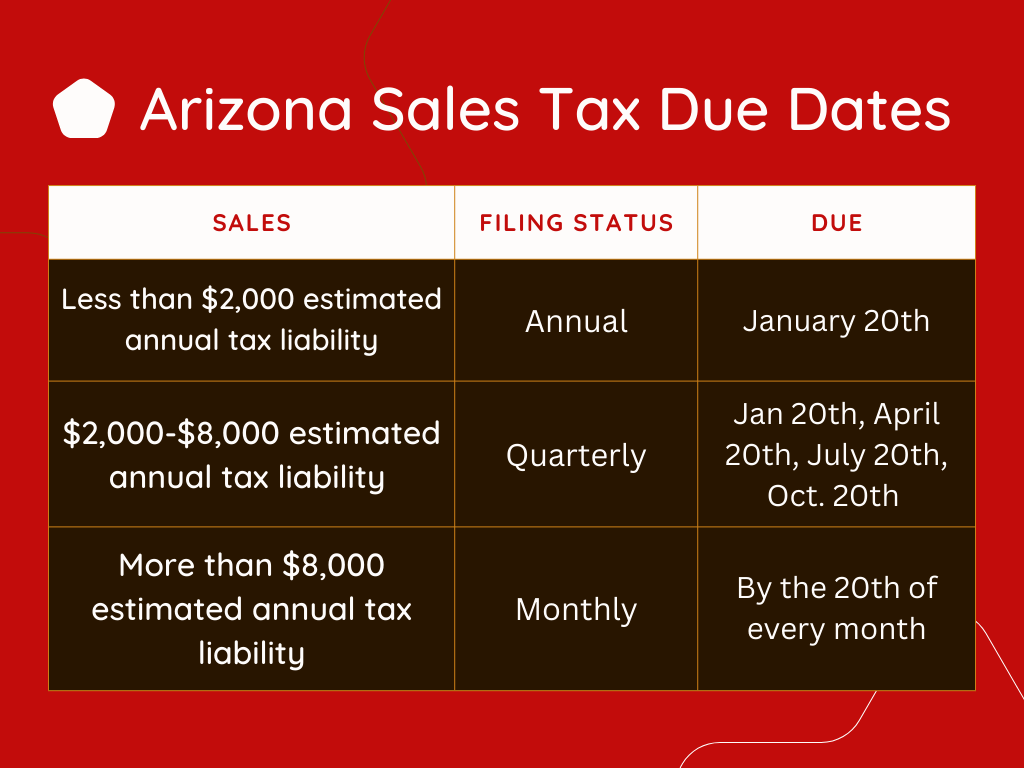
Your TPT filing frequency is based on your total estimated annual combined Arizona, county, and municipal tax liability:

Estimated Annual TPT LiabilityFiling FrequencyDue Date
More than $8,000Monthly20th of each month
$2,000-$8,000QuarterlyQ1: April 20; Q2: July 20; Q3: October 20; Q4: January 20
Less than $2,000AnnuallyJanuary 20

See ADOR’s official filing schedule for exact thresholds and due dates.

If you believe your business should be assigned a different filing frequency, you can request a change by completing and submitting the Business Account Update Form.

Regardless of your filing frequency, you must file a TPT return for every reporting period even if you had no sales and owe no tax during that period. Filing for every period and on time not only helps you avoid penalties and interest, but it can also qualify you for valuable accounting credits:

  • Electronic filers can claim a credit of 1.2% of the tax due, up to $12,000 per calendar year
  • Paper filers can claim a credit of 1% of the tax due, up to $10,000 per calendar year

Businesses that file all TPT returns electronically may also qualify for an increased accounting credit.


Save the graphic below and never miss another Arizona TPT due date!

Arizona TPT Filing Frequency

Need help filing Arizona sales tax? We can handle it for you. Visit our pricing page to see our service tiers, transparent pricing, and zero locked-in contracts.

STAY INFORMED

More Resources

Get informed on how each seller platform collects sales tax, marketplace facilitator laws, and more

Colorado Sales Tax Guide

Colorado Sales Tax Guide

Key Takeaways The state sales tax rate in Colorado is 2.90%, but total rates vary by location due to local taxes, special districts, and home rule cities, which change frequently. Businesses with physical or economic nexus are required to collect and remit sales tax...

Guide to Sales Tax in the District of Columbia: Insights

Do you need to collect and remit sales tax in the District of Columbia? Sales tax in the District of Columbia applies to all tangible personal property and selected services sold or rented at retail, whether to businesses or individuals. However, certain contexts call...

Wisconsin Sales Tax Guide

Wisconsin Sales Tax Guide

Do you need to collect and remit sales tax in Wisconsin? Whether you're an in-state business or an out-of-state remote seller, you may be required to collect and remit sales tax in Wisconsin. Here's what you need to know: Need help with Wisconsin sales tax filing? See...