
Sales Tax Registration

Register for sales tax accounts in any United States jurisdiciton.

Sales Tax Nexus Determination

Find out where you are required to collect sales and use tax in jurisdictions across the nation. 

Sales Tax Return Filing

Affordable sales tax return filing for any business type and size.

Audit Assistance

We can help you through the audit process, keeping your rights intact and potentially reducing the amount of tax, penalty, and interest assessed. 

VIEW ALL SERVICES

Understanding Sales Tax in Arizona: A Comprehensive Guide

Sales Tax by State Guide for Businesses
Are you a business owner operating in or selling to Arizona? Do you feel like the amount of sales tax information you need to track could fill The Grand Canyon? This guide breaks down everything you need to know about Arizona sales tax, (officially called Transaction Privilege Tax (TPT), including nexus rules, exemptions, digital goods, registration requirements, and filing deadlines.

Sales Tax Faqs

Economic Threshold Sales: 100,000
Statewide Tax Rate: 5.6%
Marketplace Facilitator Law: Yes

Contact Information

Arizona Department of Revenue

Key Takeaways

  • Arizona imposes Transaction Privilege Tax (TPT) rather than traditional sales tax; businesses must register if they meet physical or $100,000 economic nexus.
  • Residential rental properties are no longer taxable as of January 1, 2025, and these licenses were automatically canceled.
  • Digital goods are generally taxable in Arizona when ownership transfers to the customer, though custom software may be exempt.
  • City tax rates change frequently, with combined state + local rates reaching up to 11.2%; several municipalities updated rates in 2025.
  • Marketplace facilitators (Amazon, eBay, Etsy, Walmart) must collect and remit TPT, so most marketplace-only sellers do not need a separate Arizona license.

Do You Need to Collect and Remit Sales Tax (TPT) in Arizona? 

Along with its 45 brother and sister states, (including the District of Columbia), Arizona imposes a form of sales tax—but the correct term is Transaction Privilege Tax (TPT), which essentially means a tax for the privilege of doing business in the state.

If your business meets economic or physical nexus in Arizona, you are required to register, collect, and remit TPT.  

Are there any exemptions to Arizona TPT?

Yes. While most retail transactions are taxable, Arizona provides several exemptions. Examples include:

  • Sales for resale
  • Purchases made by qualifying nonprofits
  • Purchases made by government entities
  • Certain manufacturing purchases
  • Agricultural purchases by farmers and ranchers

To claim an exemption, buyers must provide either a Resale Certificate or an Exemption Certificate. These forms can be located here.

Are digital goods taxable in Arizona?

Digital goods and software often create confusion for sellers. Digital tax rules vary widely from state to state—and Arizona is no exception.

Arizona does not provide detailed statutory guidance on digital products, but the general interpretation is that digital goods are taxable when:

  • They are classified as a retail sale, and
  • A transferable right of use or ownership is conveyed to the customer.

However:

  • Custom-developed, one-off software is often treated as a professional service, and therefore is not taxable.
  • SaaS and streaming services fall into a gray area; treatment may vary depending on how the product is delivered.

Because digital taxation is evolving, businesses should regularly confirm how Arizona classifies their specific digital product.

(2025 update) new rules for residential rentals

Effective January 1, 2025, long-term residential rentals (30+ consecutive days) are no longer subject to TPT.

Additional updates:

  • TPT licenses containing only the “Residential Rental” classification (business code 045) were automatically canceled on December 31, 2024.
  • Property owners are still responsible for all outstanding liabilities, prior filings, and payments for periods before 2025.
  • This change does not affect short-term rentals (transient lodging), hotels, or commercial rentals—those remain taxable.


Do You Have Sales Tax Nexus in Arizona? 

Sales tax nexus is the connection between a business and a state. Each state has its own regulations on what constitutes nexus, especially the economic kind. Here are the standards of nexus in Arizona: 

Physical sales tax nexus in Arizona 

For a business to have physical sales tax nexus in Arizona, it must, in some way, have some tangible presence in the state. The most obvious example of this is a storefront. Other considerations that are made in determining physical nexus are: 

  1. Having assets or property in Arizona.
  2. Delivering merchandise or goods on company-owned vehicles into Arizona on a regular basis. 
  3. Installing or repairing property sold to customers via an employee or contractor. 

Economic sales tax nexus in Arizona 

Out-of-state sellers have economic nexus in Arizona if their gross sales or income meet or exceed $100,000 in the current or previous calendar year. This amount does not include sales made through a Marketplace Facilitator licensed with Arizona. 

What Are the Sales Tax Rates in Arizona?

The base state sales tax rate in Arizona is 5.6%. This rate is levied by the entire state, and does not including local/municipal rates. The combined rate can be as high as 11.2%.

It is important to remember that these rates are never set in stone. In 2025, several cities and municipalities changed their sales tax rates. Here are some notable updates:

  • City of Douglas – effective July 1, 2025, Douglas decreased its tax rate on Amusement Park admissions from 3.8% to 0.0%.
  • City of Phoenix – also effective July 1, 2025, Phoenix increased multiple TPT and use tax classifications from 2.3% to 2.8%. Contrary to Douglas, this included amusement park admissions, as well as contracting, hotels, restaurants and bars, retail sales, and marijuana use.
  • City of Maricopa – effective October 1, 2025, Maricopa instituted a 0.5% tax rate on most retail and business activities.

City rates change frequently, so it’s important to always consult the latest rate tables from ADOR.


Are Marketplace Facilitators Required to Collect and Remit Arizona TPT? 

Yes. Since October 1st, 2019, Arizona implemented TPT for remote sellers and marketplace facilitators, requiring each to register if they meet or exceed economic nexus.

If you sell exclusively through a marketplace, you do not have to obtain a TPT license, but you must confirm that the marketplace is registered with Arizona.

What platforms are marketplace facilitators? 

  1. Amazon 
  2. ebay 
  3. Etsy 
  4. Walmart (online) 

Not sure what a marketplace facilitator is? In short, marketplace facilitators are companies that provide a platform or service for third-party sellers (you) to sell their products or services to customers. The facilitator collects payment from the customer, processes the transaction, and may also handle shipping and returns. 

Filing Arizona Sales Tax (TPT)

Before collecting and remitting Arizona TPT, businesses must first register for a license from the Arizona Department of Revenue. Businesses that sell into multiple locations within Arizona can either license and report each location separately or have a consolidated license. Each license per location costs USD $12.00.  

There are multiple ways to apply for a TPT license: 

  1. Online at AZTaxes.gov (note that this option enables businesses to register, file and pay TPT online). 
  2. Arizona Business One Stop (For Arizona-based businesses). 
  3. Complete and mail Joint Tax Application (JT-1), or complete and hand in-person to one of Arizona’s tax offices. 

Once registered, taxpayers are strongly encouraged to file their tax returns online via AZTaxes.gov. This is due to the complexity of local TPT reporting.  

Need help filing Arizona sales tax?

We can handle it for you. Visit our pricing page to see our different Tier options, transparent pricing, and zero locked-in contracts. 

When are sales tax returns due in Arizona? 

TPT filing frequencies are decided by the business’ total estimated annual combined Arizona, county, and municipal tax liability. See the chart below for a detailed look. 
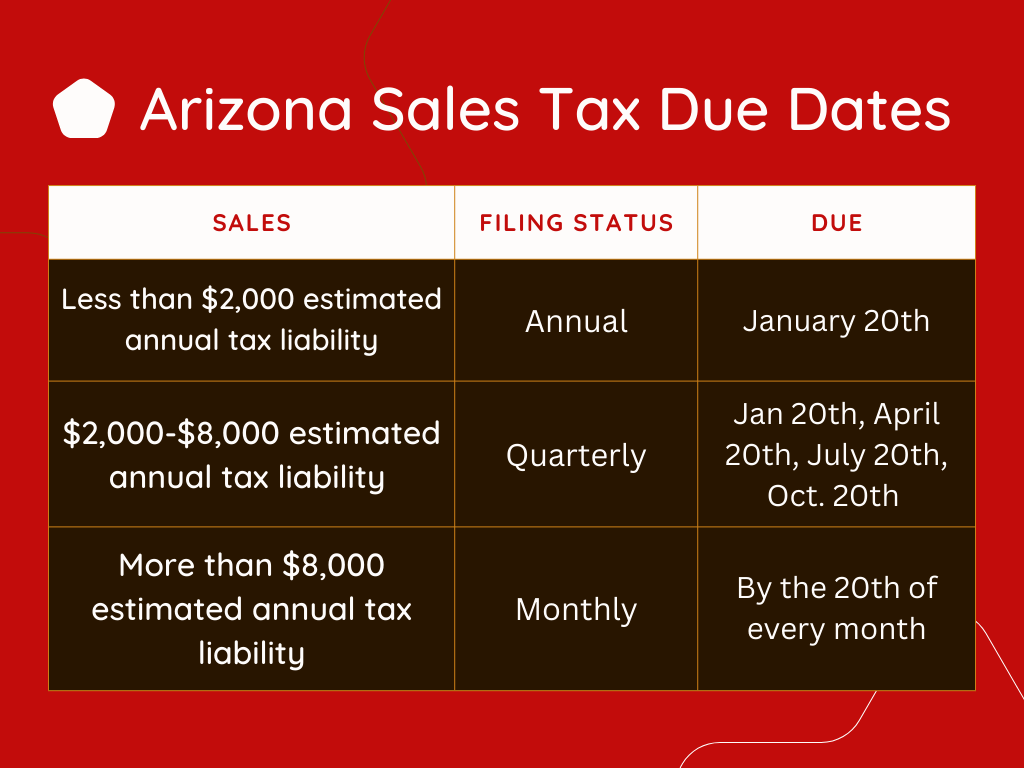
Businesses can request to change their filing frequency by completing and mailing the Business Account Update Form should their filing status not accurately reflect their tax liability. 

STAY INFORMED

More Resources

Get informed on how each seller platform collects sales tax, marketplace facilitator laws, and more

Understanding Sales Tax in Alabama: Rates and Rules

Understanding Sales Tax in Alabama: Rates and Rules

Key Takeaways for Alabama Sellers Alabama's state sales tax rate is 4%, but local rates can push the total as high as 11%. If you sell online and exceed $250,000 in Alabama sales, you must register to collect and remit seller's use tax. Food and grocery tax rates have...

Nevada Sales Tax Guide

Nevada Sales Tax Guide

Do you need to collect and remit sales tax in Nevada?  If you have economic or physical nexus in Nevada, you must collect and remit sales tax to the state. Use tax is typically imposed on property purchased outside of Nevada without tax. Sales tax is measured by gross...

Texas Sales Tax Guide

Texas Sales Tax Guide

Do you need to collect and remit sales tax in Texas?  There are two types of sales tax designations in Texas:  Franchise Tax is a privilege tax on taxable entities doing business in Texas. This applies to Limited Liability Companies (LLCs), corporations,...